
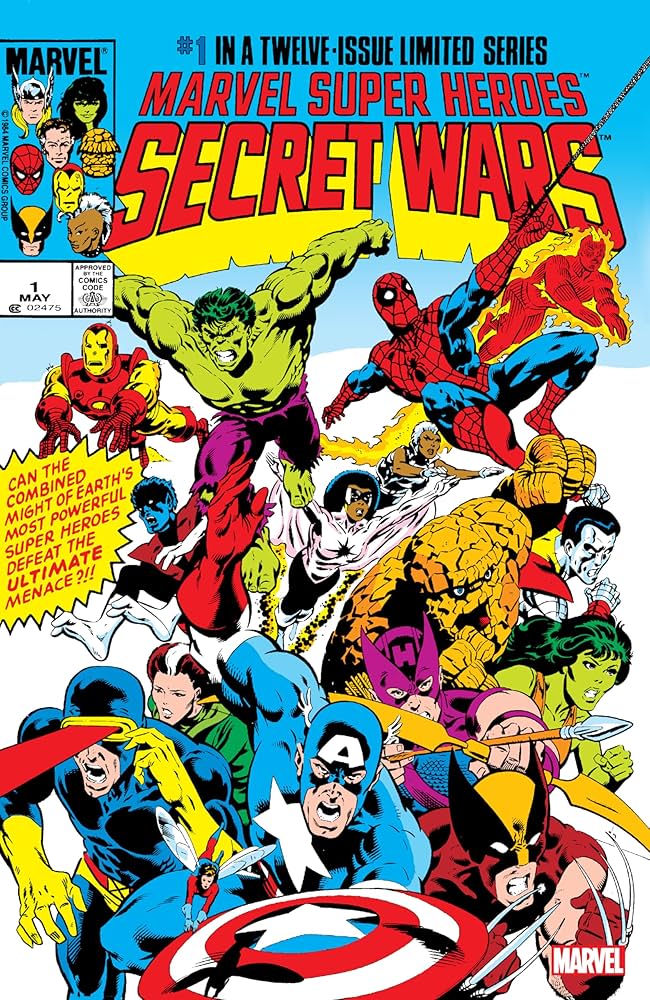
Given that the latest blockbuster movies in the Marvel franchise will be coming in the form of ‘Avengers: Doomsday’ and ‘Avengers: Secret Wars’, the critique of this comic seemed inevitable.
Plot
From the opening pages, author Jim Shooter and illustrator Mike Zeck make a clear attempt to inform readers that this piece will be a chaotic cosmic adventure.
Heroes and villains alike are trapped on a spacecraft beyond the star, and a god-like entity enters the frame while the strongest minds of the Marvel universe try to fathom what is entering their stratosphere.
As Professor X continues to try to square such a difficult circle, the dangerous Dr Doom swiftly detects a more deadly consequence approaching… unscaled warfare.
Before everyone’s eyes, they are transported to an unknown region of the galaxy that not even the most travelled hero/villain has yet to discover.
In the midst of uncertainty, chaos ensues amongst Doom and his legion of villains. Ultron is struggling to comprehend what is occurring and commences an attempted killing spree.
The god-sized entity then reveals himself to be Galactus, the devourer of worlds, and The Beyonder finally reveals himself, declaring that this world has been created as a battle arena that will see all characters collected fight to the death. Dr Doom then attempts to escape from a seemingly devastating fate through a rift that has opened.
Galactus hurls himself towards the same rift, in which The Beyonder exerts his dominance and blasts both him and Doom away, leaving the spectating cast in awe of what they have just seen.
Eventually, everybody lands on ‘Battleword’, and questions are raised amongst the heroes as to who should spearhead their unit into the fierce encounter. With several twists left in the tale, Marvel would have the ability to prolong this multiversal clash of the titans for 12 issues.
Opening with a bang
When selecting a comic to devote your free time to, a front cover’s imagery must find a way to capture your attention within a moment’s notice.
For art created in a time with less advanced technology, the 1984 volume #1 release of ‘Secret Wars’ it certainly ticks a lot of essential criteria.
The prominence of Marvel’s most loved heroes is an aspect of this cover that works perfectly. Captain America aggressively charging with his shield, Cyclops releasing signature red beams from his eyes, Spider-Man swinging into action, and Hulk bursting out of the page, ready for this limited-series comic to blow your mind.
Undoubtedly, this is the exact level of art that must be expected of an omega-level story such as this. Whether the execution on the inside matches the ambition of the exterior is very debatable.
Poor dialogue derails potential classic
We now live in a day and age where humans rage against the use of machinery and AI, complaining that this technology is stealing jobs away from people who actually need them. In the case of this comic, this kind of intelligence would have salvaged an opening volume that wielded so much potential.
As a Marvel fanatic, who had so much hope and clamour for an idea this ambitious, I was left bitterly disappointed and downright bored at what I was reading.
Given that the action was limited due to setting up an entire series, dialogue matters. In this case, dialogue failed. Each bubble of speech felt robotic and lacking any form of meaningful emotion.
Words of this scale must grab the reader. The author had the earth’s mightiest heroes at his disposal and the most cunning villains. However, nothing about this comic enticed me to read another episode.
For example, Ultron is a villain shaped around self-teaching artificial intelligence, and essentially the birthchild of the smartest minds on Earth — Tony Stark and Bruce Banner. He felt about as articulate as a toddler before going on a rampage due to his lack of perception of the situation before him.
Maybe this was a sign of the times, but it was simply a woeful attempt at becoming a classic.
Dr Doom is integral to this series
One character written with great effect is Dr Doom. It is obvious by the focus of each scene that this is the villain that Marvel will attempt to mould ‘Secret Wars’ around.
His actions mirror his intelligence. Placed in a scenario that he has never encountered, has yet to analyse, and where the landscape and situation are changing with every given minute, he appears to be the only character willing to evolve throughout each page.
When escape is not an option, Doom tries his luck with manipulating his evil comrades. When this does not work out, he tries his luck with negotiating with the very foes that would try to smite him.
In comparison to other wicked characters, Victor Von Doom sticks to the selfish, power-hungry and intelligent principles that have made him one of the deadliest men in the universe. Whereas other villains appear happy to willingly hand over the leadership role to Doom, rather than seeking the very power they have always been so desperate to hold.
Dr Doom is the beacon of hope of this comic.
Review: 5/10
Overall, this is a story that possessed unhinged potential to commence an arc that had never been attempted in the Marvel Universe — it failed on that premise.
Yes, this is only the first of a 12-volume series, but to begin with, such a limp dialogue and a lack of chaos were hugely disappointing.
Cosmic entities such as The Beyonder and Galactus barely showcased their levels of intimidation, while other villains seemingly had a personality transplant. They were weak. Uninspiring. Barely mischievous. If you offered them to steal candy from a baby, they most likely would have burst into tears and questioned why you would suggest such an action.
As previously mentioned, the extraterrestrial artwork and Dr Doom’s consistent character arc salvaged a very disenchanting effort. Apart from these two factors, the 1984 version of ‘Avengers: Secret Wars’ was nothing short of dull, dreary, and I would not return for a second glance.
 The Superhero Critic
Leave a comment